
Sprint planning is underway. The team has a backlog full of user stories. Before anyone writes a single line of code, they spend the next two hours creating tasks, assigning owners, and estimating hours.
This probably sounds familiar; most Scrum teams do it. But here’s the question worth asking: does it actually help?
Despite being a near-universal practice, task creation during sprint planning gets almost no scrutiny. Teams do it because they’ve always done it, because their ScrumMaster told them to, or because it feels productive. But feeling productive and being productive are not the same thing.
Let’s take a look at what’s actually happening and whether the time and effort is worth it.
What Task Creation in Sprint Planning Usually Looks Like
Most teams follow some version of this process for each user story in the sprint:
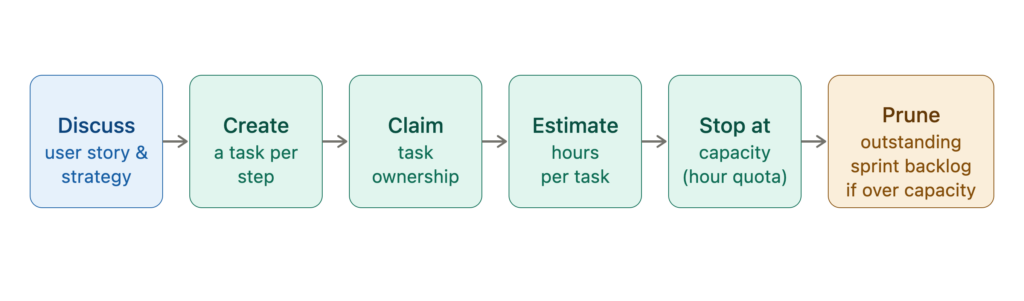
It’s methodical. It feels thorough. And it consumes a significant chunk of sprint planning time every single sprint.
Why Do Teams Do This?
Ask around and you’ll hear four common justifications:
- To figure out all the implementation steps upfront
- To clarify who will do what
- To create hour-level estimates for the work
- Because the ScrumMaster said so
Let’s look at each one honestly.
Reason 1: “We Need to Figure Out the Steps in Advance”
The logic here is appealing: plan ahead, avoid confusion later, save time overall. The problem is that it only works in a narrow slice of situations.
When the story is new or complex, you’re essentially guessing. You might spend an hour in sprint planning generating your best estimate of the steps involved only to discover within the first day of implementation that your assumptions were wrong. The actual steps emerge as the team learns more about the problem. In this case, the time spent on tasks wasn’t just wasted; it may have actively pointed the team in the wrong direction. You end up building something suboptimally, not realizing it until the end of the sprint, and then carrying rework into the next one.
When the story is familiar, task creation becomes theater. Teams develop “boilerplate” task lists for common story types after a few sprints, and team members often don’t even look at the tasks until they’re ready to close them. If the steps are always the same, why aren’t they captured in your definition of done? Or in shared team knowledge? Spending five to fifteen minutes every sprint creating tasks that nobody references is time that could be spent delivering value.
The insight here isn’t that planning is bad, obviously. Instead, the right kind of planning happens at the right time, which is often during implementation, not before it.
Reason 2: “We Need to Know Who’s Doing What”
This reasoning makes sense if your mental model is still rooted in waterfall delivery, where work is divided among individuals working largely in parallel silos, often planned months in advance.
Scrum operates on a different assumption: the team succeeds or fails together. High-functioning Scrum teams swarm on work, pair on hard problems, and share ownership of outcomes rather than parceling out individual assignments.
Task ownership can also create awkward situations where someone finishes their tasks early and sits idle rather than jumping in to help a teammate who’s struggling. The sprint becomes a collection of individual to-do lists rather than a shared commitment.
If your team is newer to Agile, some early task assignment can help with orientation. But the goal should be to grow out of it, not to institutionalize it as a permanent practice.
Reason 3: “We Need Hour-Level Estimates”
Agile explicitly pushes away from hour-based estimates. The entire point of story points, or any relative estimation technique, is to avoid false precision and the overhead of detailed time estimates. Teams spend real energy learning to estimate at the story level so they can plan without overpromising.
And then, in sprint planning, those same teams decompose each story into a list of tasks and estimate each task in hours.So you’ve done the high-level estimate to avoid false precision. And then you’ve immediately done the detailed estimate anyway, just one level down.
If your hour estimates at the task level were reliably accurate, this might be defensible. But task estimates are often as unreliable as the story estimates they were meant to replace. The work takes longer than expected. Tasks get added mid-sprint. The original estimate bears little resemblance to reality by day three.
What are the hour estimates actually being used for? If the honest answer is “to fill capacity on the sprint board” or “because we’ve always done it,” that’s worth examining.
So What Should Teams Do Instead?
None of this means teams shouldn’t think before they build. It just means the form of that thinking matters.
A few alternatives worth considering:
Use your definition of done as a task replacement. If certain steps happen on every story (code review, automated tests, documentation update, deployment to staging), those belong in the definition of done, not recreated as tasks every sprint.
Let tasks emerge during implementation. For complex or novel stories, the team will naturally surface what needs to happen as they start working. A quick standup conversation or a 10-minute huddle at the story level often accomplishes more than an hour of upfront task breakdown.
Focus sprint planning on shared understanding, not assignment. The most valuable sprint planning conversations are about what the story needs to accomplish and what done looks like, not who owns which sub-task. Teams that nail that conversation tend to self-organize effectively without pre-assigning work.
Reserve detailed breakdown for genuinely complex items. Some stories are large enough or unfamiliar enough that a brief task sketch is useful. That’s fine. The question is whether you’re doing it selectively, based on need, or reflexively, based on habit.
The Bigger Point
The Scrum Guide doesn’t mention task creation. It doesn’t mention user stories either, for that matter. These are practices that evolved in the community; some useful, some not, many somewhere in between depending on context.
The teams that improve fastest aren’t the ones that follow Scrum most faithfully. They’re the ones that constantly ask: Is this adding value? Is this helping us deliver better outcomes? Or are we just going through the motions?
Task creation isn’t inherently wrong. But doing it reflexively, for every story, every sprint, without examining the return is the kind of low-visibility waste that quietly drains team energy without showing up on any metric.
The goal is to deliver. Everything else should be in service of that.
Does Your Team Have More Process Than Progress?
At Sprightbulb, we help teams cut through the ritual and focus on what actually improves delivery. Whether you’re seeing your teams go through the motions of Scrum without the results, or you’re mid-transformation and wondering why things aren’t clicking, our coaches and trainers have seen it all and helped teams navigate it.
We don’t show up with a framework prescription. We work with you to understand what’s getting in the way, build internal capability, and create sustainable change that lasts after we’re gone. Learn more.