
If you hold a Scrum Alliance certification, you already know the credential doesn’t last forever. Every two years, you’ll need to renew, and that renewal requires more than a fee. It requires proof that you’ve kept learning. That’s where Scrum Education Units (SEUs) come in.
This guide explains what SEUs are, why they matter beyond the paperwork, and five practical ways to earn them, including a few strategies most people overlook.
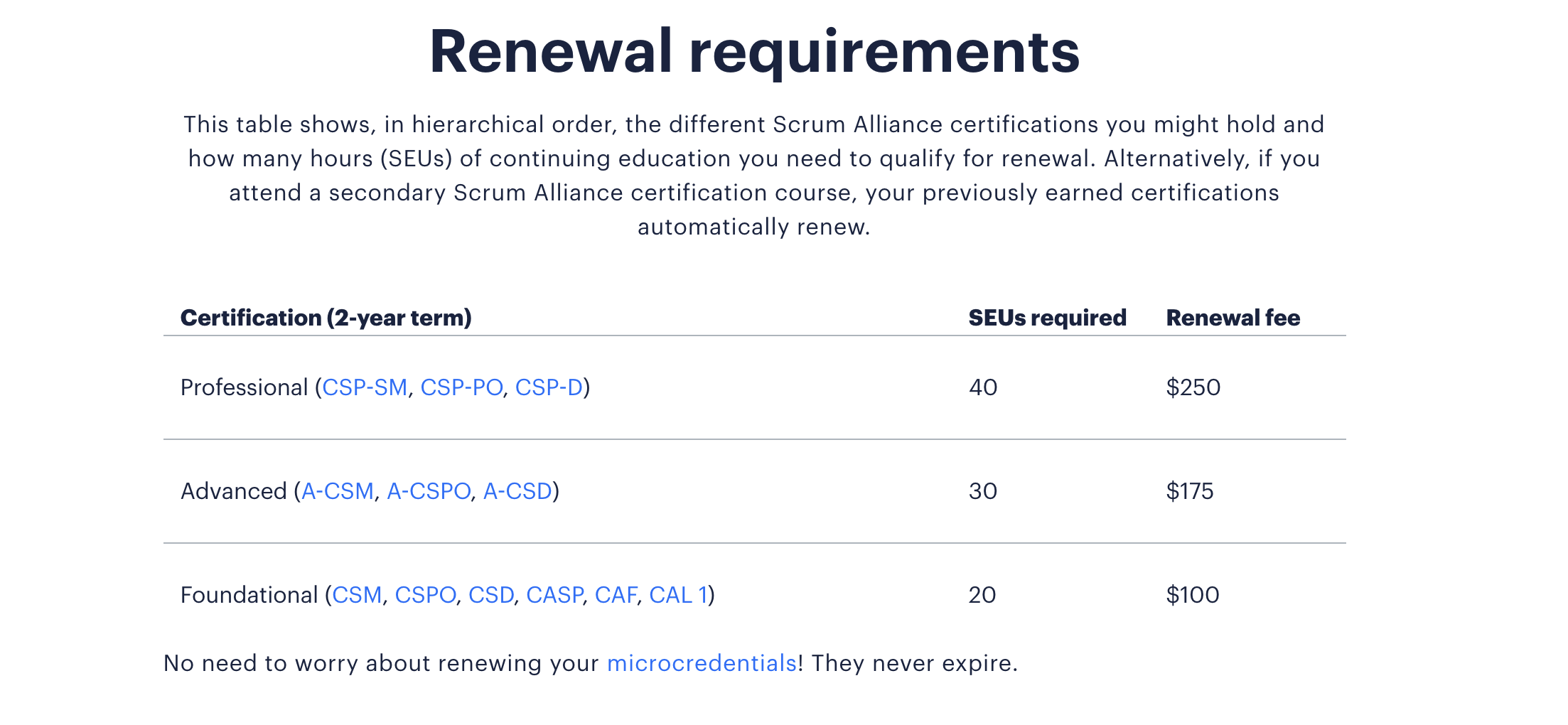
ScrumAlliance renewal requirements
What Are Scrum Education Units (SEUs)?
SEUs are the Scrum Alliance’s way of measuring continued professional development. The math is simple: one hour of qualifying learning equals one SEU. That learning can take many forms: attending events, completing training, self-guided study, volunteering, or certain on-the-job activities.
Every Scrum Alliance certification requires a specific number of SEUs for renewal. The CSM and CSPO, for example, each require 20 SEUs over a two-year certification period, along with a renewal fee.
But SEUs are more than a renewal checkbox. They’re a useful structure for staying current in a field that keeps evolving. Scrum practitioners who engage consistently with new ideas (hearing different perspectives, practicing concepts in new contexts, and pushing their own thinking) tend to be far more effective than those who treat certification as a destination.
How to Earn SEUs: Approved Categories
The Scrum Alliance accepts SEUs across several categories:
- Attending conferences and events (in-person or virtual)
- Completing training courses
- Self-guided study (reading, research, online content)
- Volunteering
- Relevant on-the-job experience
The flexibility here is genuinely useful. You likely accumulate SEU-eligible activity without realizing it. The key is being intentional and keeping records.
5 Practical Tips for Earning SEUs
1. Attend Multi-Day Events for a Quick SEU Boost
Since SEUs accrue at one per hour, a full-day or multi-day event is one of the most efficient ways to build your count quickly. Many virtual events are low-cost or free. Plus, the community-learning format often generates more practical insight than solo study. Look for Scrum Alliance-hosted virtual events, industry Agile conferences, and community summits. A single two-day event can yield 8 or more SEUs while also exposing you to practitioners working through challenges similar to your own.
2. Join Webinars and Community User Groups
Webinars and local Agile user group meetings are among the most underused SEU sources. They’re typically free, they’re genuinely community-driven, and they count. Participating in grassroots community events has the added benefit of connecting you with other practitioners who are navigating the same real-world Agile complexities you are. One hour at a user group meeting is one SEU, plus a conversation worth having.
3. Count Your Self-Guided Study
Reading articles, exploring the Scrum Alliance resource library, and researching Agile topics on your own all qualify for SEUs. The Scrum Alliance website often displays the SEU value directly on individual articles so you always know what you’re earning. Self-guided study is also the most flexible category: you can accumulate SEUs while deepening your thinking on a specific challenge your team is facing right now. That’s learning that pays double.
4. Volunteer Your Skills
If you’re applying Scrum or Agile facilitation skills in a volunteer context (helping a nonprofit, mentoring a community team, or serving as a ScrumMaster for a local organization), those hours count toward SEUs. This is a meaningful way to give back to your community while continuing your professional development. Track your hours, document what you did, and claim them.
5. Take a Scrum Alliance–Certified Training Course (and Save Yourself the Renewal Fee)
Here’s a detail that surprises many practitioners: if you earn a new Scrum Alliance certification, it automatically renews your existing Scrum Alliance certifications to match the new date. You don’t need to claim SEUs separately, and you avoid the individual renewal fee for the older certification.
For example, if your CSM is 18 months old and you complete a CSPO course, your CSM renewal date resets to match your CSPO. On your unified renewal date two years later, one set of SEUs and one renewal fee covers both certifications.
All of Sprightbulb’s Scrum Alliance–certified courses count toward SEUs, and completing one of those certifications automatically renews your other active Scrum Alliance credentials. If you’ve been putting off that A-CSM or CSPO, the renewal math might be the extra nudge you needed.
Keep Learning Beyond the Credential
Certifications open doors. Continued learning is what helps you walk through them confidently. SEUs are a useful prompt to ask, every year or two: what have I learned, and where do I want to grow next?
If you’re exploring your next step, whether that’s advancing on the ScrumMaster track, moving into product ownership, or deepening your Agile leadership skills, Sprightbulb’s course catalog covers the full spectrum of Scrum Alliance pathways, from CSM through CSP-SM, and CSPO through A-CSPO.
Ready to earn SEUs and grow your practice? Explore Sprightbulb’s upcoming courses
Additional Resources from the Scrum Alliance
Maintaining Your Certification